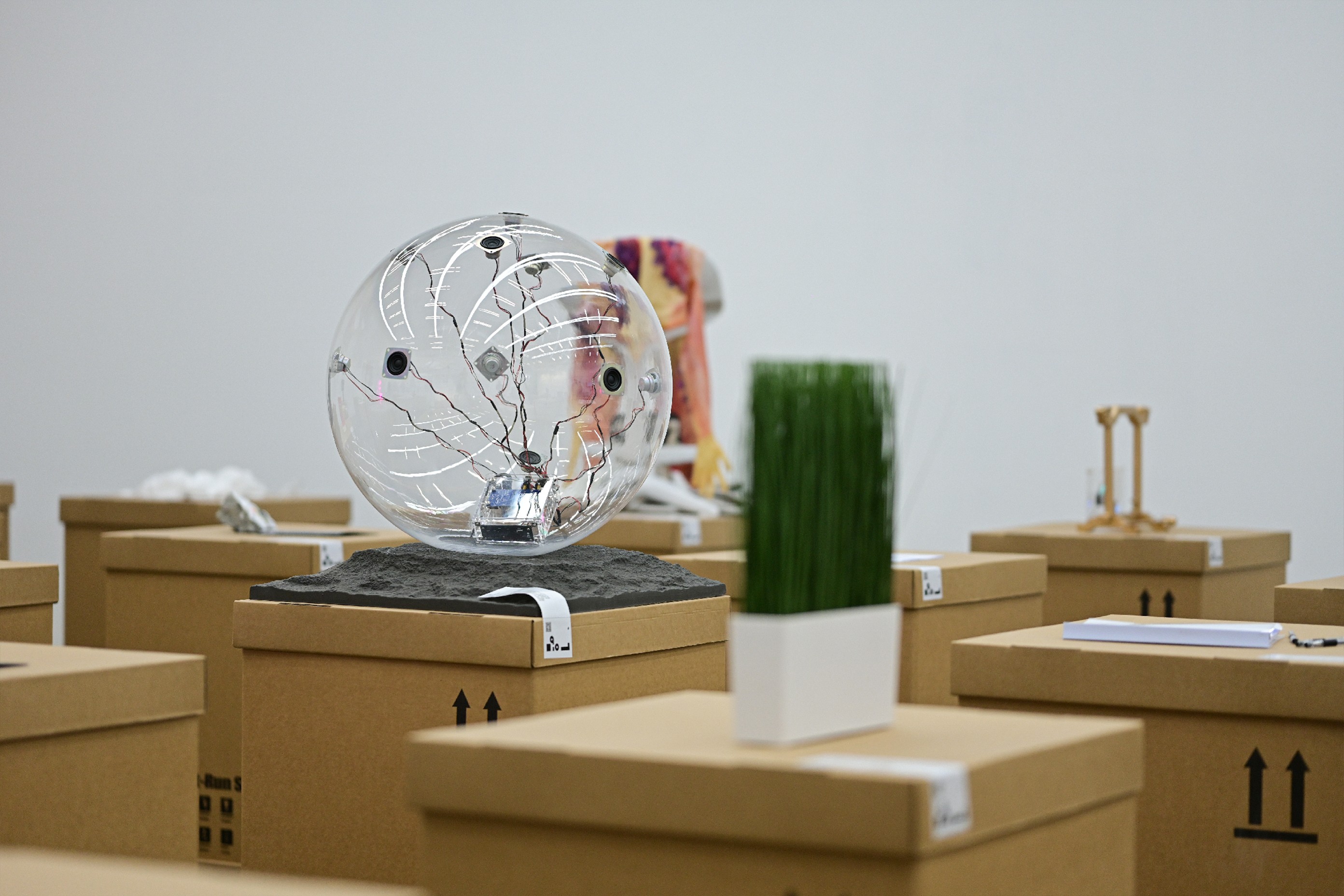
Guardian Art Center, No. 1, Wangfujing Street, Beijing
Ruiyun Ba(巴瑞云), Cen Chen(陈岑), Cheng Hua(华成),
Chuan Lu(陆川), Nix Liu&Yuting Zhu(刘 鑫&朱雨婷), Allen Ren(任伦), Songjian Su(苏永健), Arlene Sun(孙小画)
Cardboard Boxes ·
Computing Power · Nomads: Transformations in Modes of Artistic Production
Cardboard Boxes ·
Computing Power · Nomads: Transformations in Modes of Artistic Production
The exhibition examines how technological change is reshaping the ways young artists in China make art, and how that change affects the relationships among artists, studios and artworks. Rather than placing finished works alone at the centre, the exhibition turns towards artists themselves: their emotions, site-specific practices, everyday lives, storytelling, and the conditions of living and working. Drawing on field research, it follows the processes through which their works are made and identifies three figures within these changing modes of production: the cardboard box, computing power and the nomad.
In a rapidly globalising world, the cardboard box has become an image of production, consumption and the global division of labour. It is also a material link in the movement of things, including artworks. Boxes carry works from one exhibition site to the next; their standardised form makes transport, circulation and exhibition more efficient. They also participate in the production and reproduction of art: materials arrive in them, found objects are adapted, and works are packed in parts before being assembled elsewhere. One might even imagine the box as a studio in miniature, able to travel. Information moves through networks, while physical objects still move in countless boxes. The cardboard box condenses the material conditions of artistic production and the circulation of art as a commodity into a single object.
Computing power originally described a computer’s capacity to process information. It has since become a central productive force in the digital economy and a foundation for wider digital change. It has opened up artistic environments ranging from the metaverse and crypto art to virtual exhibitions. For viewers, these developments offer new forms and greater volumes of work, but they also prompt a return to questions of who makes art, how it is made and how its labour is valued. We see a renewed attraction to the handmade and the raw, criticism of the perceived loss of singularity in art produced on an industrial scale, and even the repackaging of labour costs.
For artists, the computing power of their equipment sets limits on what they can simulate. Computer-assisted digital sculpture can model and refine the detail of a work; game engines can create striking virtual scenes. Computing power has entered artists’ lives, thinking and practice in ways that cannot simply be reversed. It expands the media available to them and asks us to reconsider what a studio needs to be. As making becomes less bound to a fixed physical site, perhaps the studio, as we have known it, will become history.
In the historical sense invoked here, youmin, or “nomads”, referred to people who had lost access to the means of production and stood outside the established social order. Their culture was both a vital presence and an unpredictable force in life beyond official institutions. Within the exhibition, the nomad also names the artist’s movement through space and a freer state of making. In Digital Nomad (1997), Tsugio Makimoto and David Manners imagined a life and work no longer tied to a fixed location, with people moving across social and cultural spaces. What they anticipated has become part of everyday life. The studio was once a central resource for artistic production, valued for its fixed location, local character and particular conditions. Those qualities no longer define where art can be made. Production can take place in a rented room, a café, a factory, the boot of a car or even a meeting in the cloud. For an artist, the studio may increasingly become a symbolic marker of a profession, and a way of remaking one’s identity within it.
These changes can be understood on two levels. The first concerns production and consumption within a global division of labour. As tools change, productive forces develop and relations of production shift. Such changes extend into social life: technology now moves faster than social relationships can adjust, affecting how we live, produce, consume and transport things. The second level concerns artistic practice. Artists adapt to changing relations of production, discover new possibilities for making and develop new artistic concepts. From mail art to net art and other forms of new media art, the interplay of art, technology and social systems has enabled experiments with tools, media and ways of working.
The exhibition approaches this inquiry along two axes, art and context, through six elements: the artist, the studio, the artwork, the contemporary context, the personal context and the historical context. It brings together artworks, objects, fragments of studios, moving images, materials, documents and manuscripts. We seek to offer visitors a detached perspective, from which they can look beyond finished works to the lives, emotions, thoughts and working conditions of the artists who made them—and see the many ways artistic production is changing today.