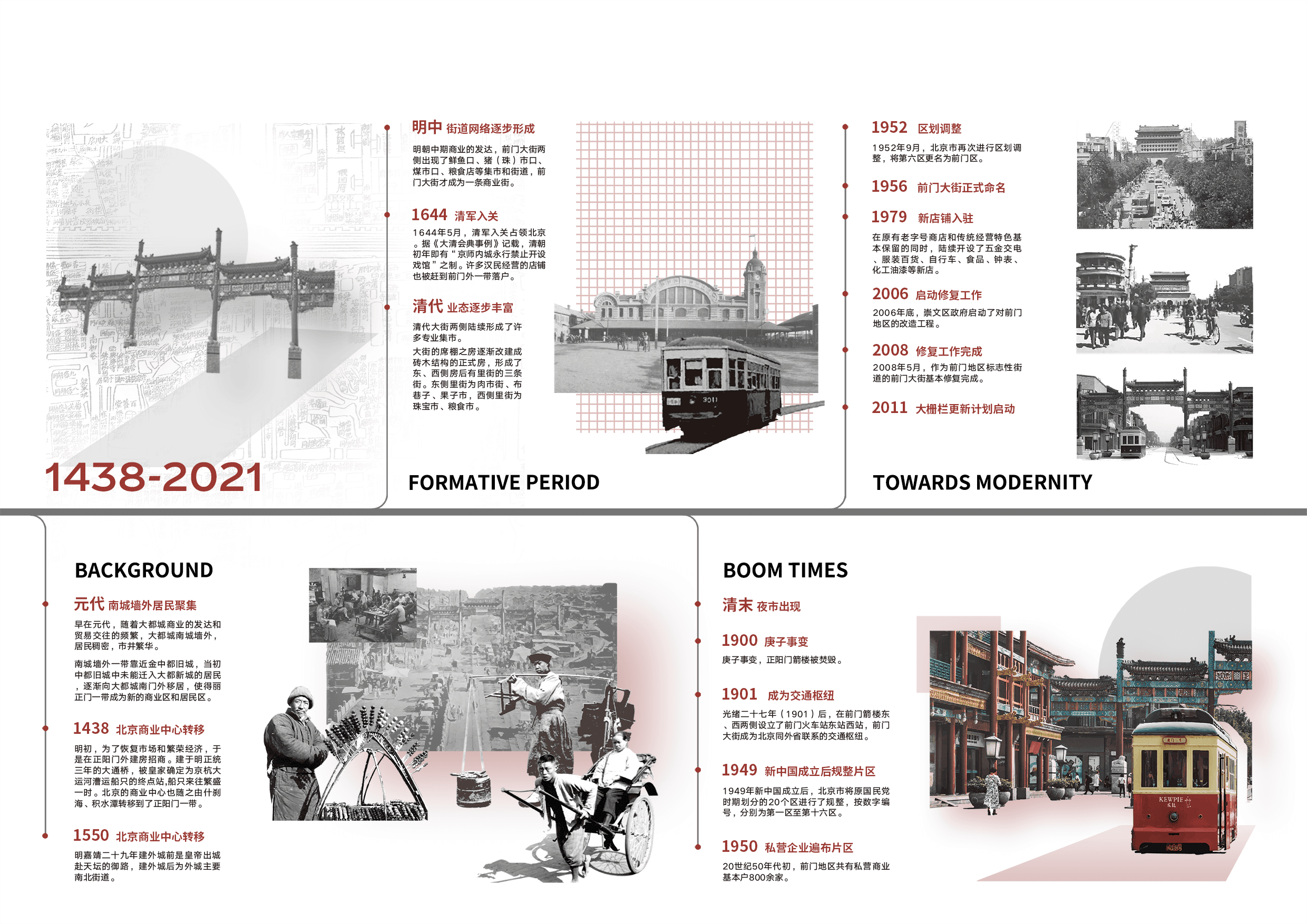
Qianmen Street is situated on the southern section of Beijing’s Central Axis, a historic urban commercial thoroughfare with over 600 years of history. Originally an imperial ritual route for emperors to conduct sacrificial ceremonies at the Temple of Heaven and the Altar of the God of Agriculture, it was known in ancient times as Tianjie (Heavenly Street). After Beijing’s Outer City was built during the Jiajing reign of the Ming Dynasty, Qianmen Street developed into the Outer City’s main arterial road. Merchants and provincial guild halls converged here. Street vendors erected mat‑woven canopies and makeshift stalls, gradually transforming the area into the capital’s most bustling civic‑commercial quarter.
Drawing from the urban vernacular symbol of rudimentary sun‑shade canopies used by street vendors in the late‑Qing and early‑Republican periods, the design abstracts this motif into a cluster of modular canopy installations. These structures are deployed across plazas and spatial nodes along Qianmen Street. Visitors may walk through, linger, and take part in arranging the installations. Lit by night‑time lighting, the site is transformed into a new public cultural living‑room.
July,2021
Designed by Richie Xiang, Zhanrong Cao
Public art design on Qianmen Street