Aura Sun’s Path: To Enchant
Aura Sun’s Path: To Enchant
Artist Research and Archive
Artist Research and Archive
Here, the piano does not record the lyricism of a melody. Sound is folded back into its interior, closer to a moment of outcry and frenzy. Aura Sun once spoke of her experience playing the violin. What truly captivated her was the intricate structure of the instrument itself, as well as those moments in playing that made her tremble: "the friction between bow hair and strings, the strings' vibrations against the left jawbone, the changes within the body as the forearm extends, and the moment when particles of rosin are released into the air". Completing a piece of music became difficult, because her attention was so easily drawn to these localised, subtle vibrations.
What Sun senses in an instrument is the musicality of the object itself. Thus, in her work, music often occurs before it becomes melody. The instrument opens a path from the object into the depths of life. Its force acts on intuition, feeling and the psyche.
Meanwhile, entangled with this psychic force are questions posed by the real world: Why make art? How can one establish an authentic self? How can one honestly excavate one’s own artistry? In Sun’s work, the search for answers becomes layers of membrane, continually changing in form.
In Delicate Frenzy (2026), the sheets of music covering the keys are unmarked by notes. Silence is a form of resistance. Even before a sound is heard, something has begun to seep through; a repressed inner chaos starts to cry out. Here the membrane “cuts off sound,” allowing an inexpressible feeling to acquire vibration, structure and rhythm.
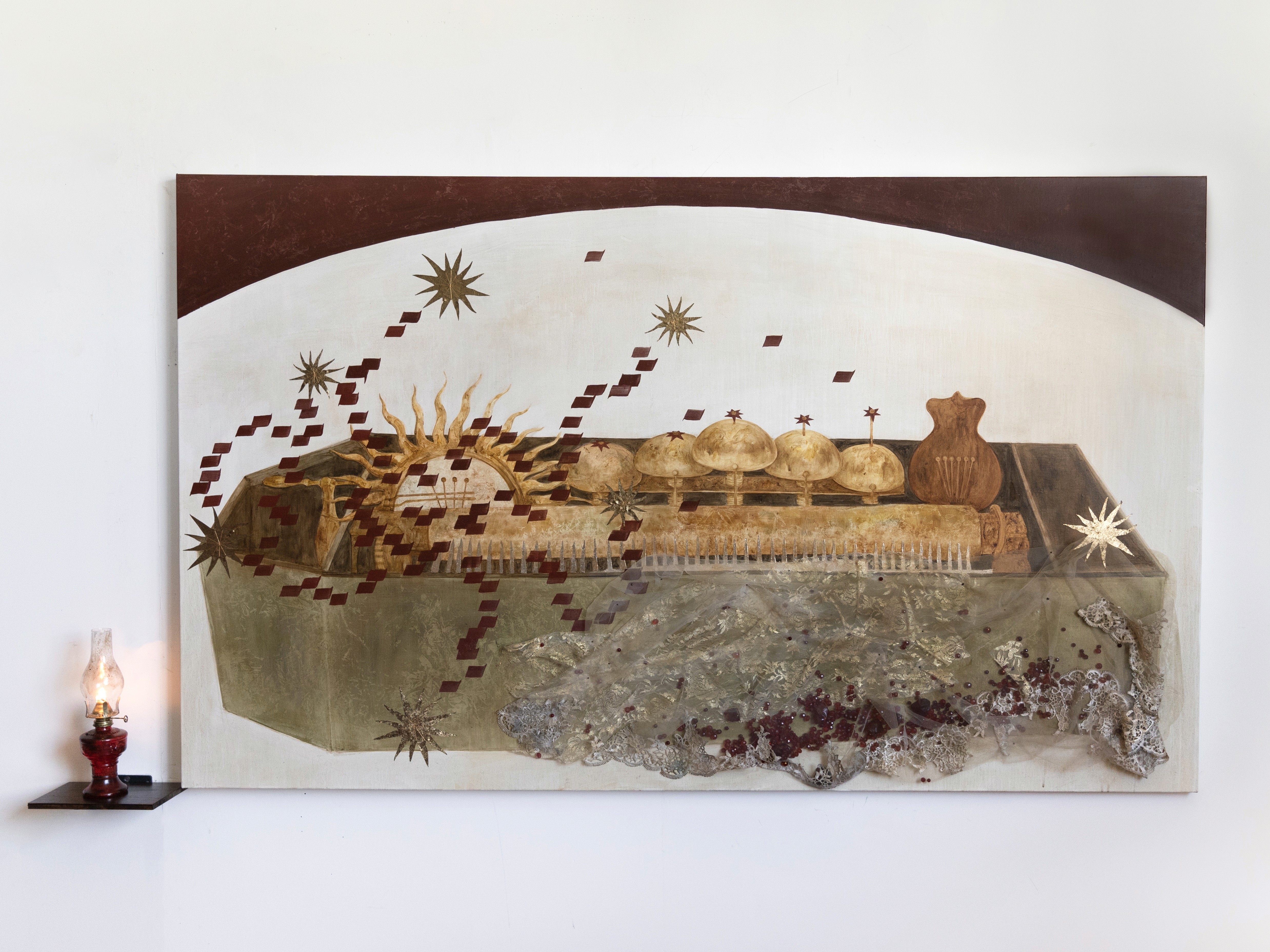
In Knock Knock the Interred Stars (2026), the membrane changes state. It appears as a piece of silvery-grey lace in the lower right of the canvas. The lace no longer blocks the instrument's sound; it begins to hold sound within it. As the inner world slowly opens, the lace receives and encloses the red hearts that emerge. At some barely perceptible moment it sets the mechanism of a music box in motion, resonating in concert with the golden sun, flickering stars and red diamonds. Here, the membrane is a skin that breathes and stretches.
Here, the piano does not record the lyricism of a melody. Sound is folded back into its interior, closer to a moment of outcry and frenzy. Aura Sun once spoke of her experience playing the violin. What truly captivated her was the intricate structure of the instrument itself, as well as those moments in playing that made her tremble: “the friction between bow hair and strings, the strings’ vibrations against the left jawbone, the changes within the body as the forearm extends, and the moment when particles of rosin are released into the air”. Completing a piece of music became difficult, because her attention was so easily drawn to these localised, subtle vibrations.
What Sun senses in an instrument is the musicality of the object itself. Thus, in her work, music often occurs before it becomes melody. The instrument opens a path from the object into the depths of life. Its force acts on intuition, feeling and the psyche.
Meanwhile, entangled with this psychic force are questions posed by the real world: Why make art? How can one establish an authentic self? How can one honestly excavate one’s own artistry? In Sun’s work, the search for answers becomes layers of membrane, continually changing in form.
In Delicate Frenzy (2026), the sheets of music covering the keys are unmarked by notes. Silence is a form of resistance. Even before a sound is heard, something has begun to seep through; a repressed inner chaos starts to cry out. Here the membrane “cuts off sound,” allowing an inexpressible feeling to acquire vibration, structure and rhythm.
In Knock Knock the Interred Stars (2026), the membrane changes state. It appears as a piece of silvery-grey lace in the lower right of the canvas. The lace no longer blocks the instrument’s sound; it begins to hold sound within it. As the inner world slowly opens, the lace receives and encloses the red hearts that emerge. At some barely perceptible moment it sets the mechanism of a music box in motion, resonating in concert with the golden sun, flickering stars and red diamonds. Here, the membrane is a skin that breathes and stretches.
Exhibition Time:
8 Aug — 9 Sep 2026
Curator and author:
Richie Xiang
Institution:
SOOFA, Shanghai.
Delicate Frenzy. 150 x 200 cm, ilk, brass candlestick, beads, oil on canvas, 2026
Knock Knock The Interred Stars, 120 x 200x 4cm,Mixed media on canvas, 2026
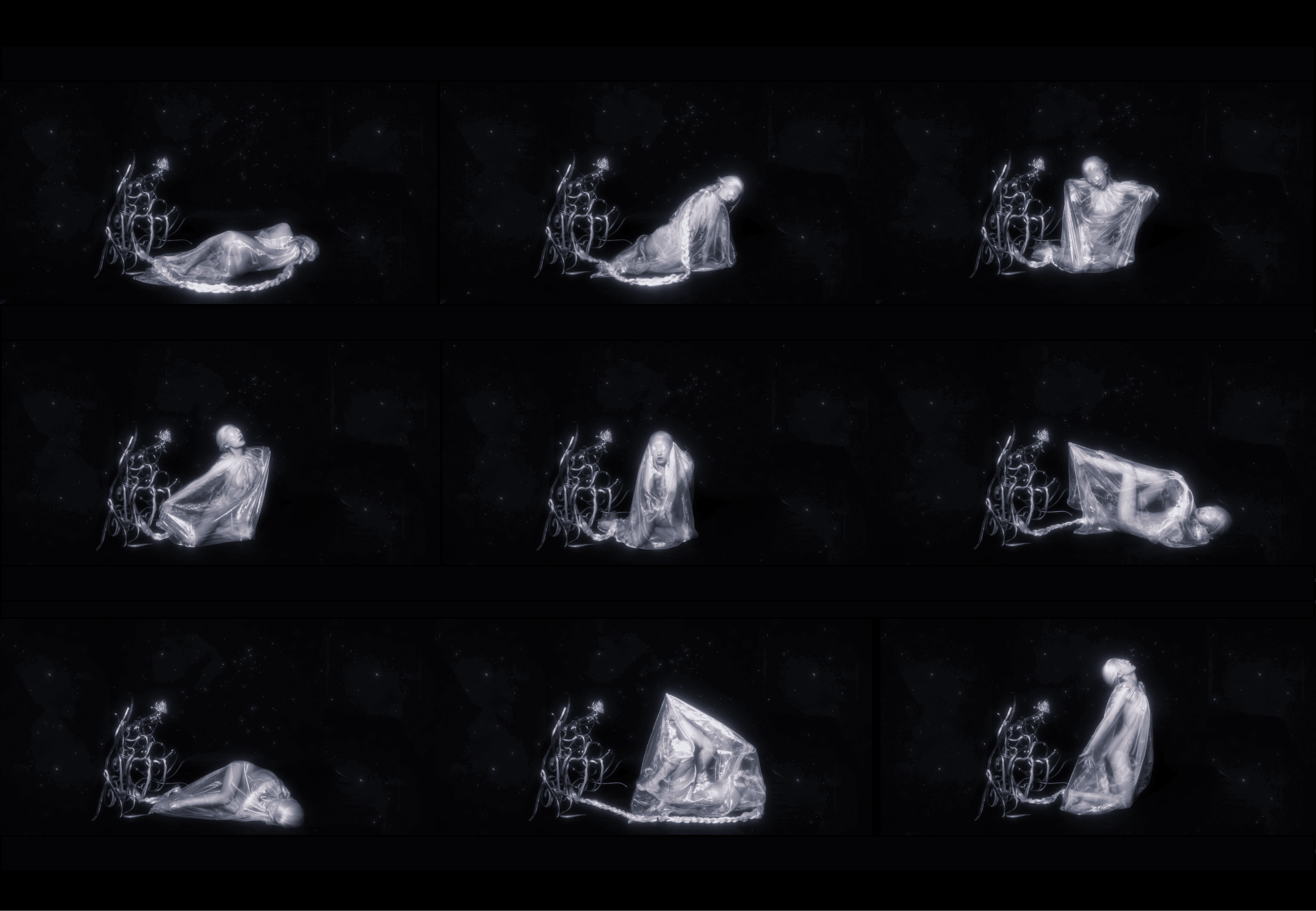
Ectoplasm. Metal, high-temperature wire, fabric; performance installation. Dimensions variable, 2025
Separation, containment and mutual shaping: these three states of the membrane do not form a linear path in Sun’s work. Even though she describes giving her works these membranes as an intuitive act, a synchronic order can still be felt within that intuition. The three states resemble interlocking conditions: some feelings must be temporarily isolated; certain shadows must be accepted and transformed; some beliefs must pass through repeated struggle and tension.
Concepts and research were not Sun’s starting point in contemporary art. She gave herself wholly to the vibrations produced by instruments and allowed them to draw her inward. From this perspective, objects, materials, images and even the body may become "instruments" in her work. What they contain is the power to give vibration, structure and rhythm to what cannot be seen.
Separation, containment and mutual shaping: these three states of the membrane do not form a linear path in Sun’s work. Even though she describes giving her works these membranes as an intuitive act, a synchronic order can still be felt within that intuition. The three states resemble interlocking conditions: some feelings must be temporarily isolated; certain shadows must be accepted and transformed; some beliefs must pass through repeated struggle and tension.
Concepts and research were not Sun’s starting point in contemporary art. She gave herself wholly to the vibrations produced by instruments and allowed them to draw her inward. From this perspective, objects, materials, images and even the body may become “instruments” in her work. What they contain is the power to give vibration, structure and rhythm to what cannot be seen.
Aura Sun once described an object calling to the psyche: "The moment I saw the fishhook and fishing net in a museum in Hungary, I knew that I had to return to my hometown. It was as though the hook had caught hold of my heart and drawn it straight back to the sea. Everything in my world now leads back to the sea."
From 2024 to 2025, Sun studied sculpture at the Royal College of Art in the United Kingdom. The academy and the exhibitions she took part in tried, day after day, to measure her practice through concepts, themes, language and methodology, drawing up inventories of meaning and value. At unavoidable exhibitions and social gatherings, her body responded politely to the gaze of others, while inwardly she had already withdrawn. The hook from the Hungarian museum drew her back toward the sea of her hometown.
Toward the end of 2025, Sun returned to Rizhao, Shandong, and entered a period of working in near-total seclusion. She reduced her material needs and social contact to a minimum, listening only to the voice within.
If, at first, the fishhook symbolised a call to return, then once she had actually returned to the seaside, that pull did not cease. The very fishhook that had once brought her back to her hometown from afar changed direction; in her artistic practice, it became a weapon, piercing those parts of herself that remained unrecognised, and calling forth an uncompromising truthfulness in her work.
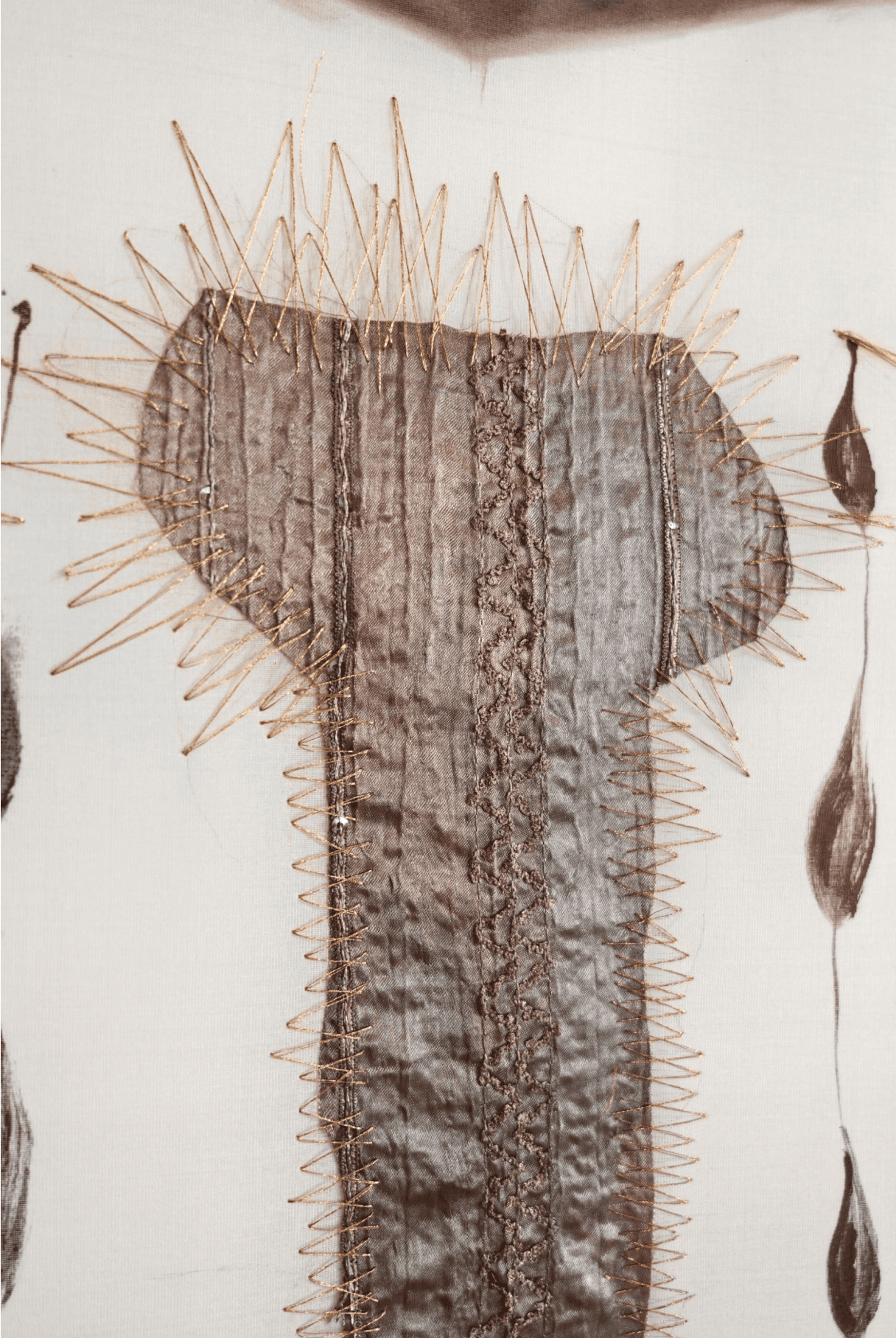
This force, which shifts from "calling back" to "piercing inward," appears in A Calm, Calm, Calm Crucifixion (2026). Three nails are arranged in sequence, while harpoons stretch the silk taut from both sides. The nails fix; the harpoons pierce. Between them is a dull but persistent pain, one that awakens the body’s instinctive desire to recoil. The outlines of the nails are repeatedly crossed, stitched and layered with thread, as if certain pains have been lived through, seen and accepted, and eventually no longer need to be told again and again.
Aura Sun once described an object calling to the psyche: “The moment I saw the fishhook and fishing net in a museum in Hungary, I knew that I had to return to my hometown. It was as though the hook had caught hold of my heart and drawn it straight back to the sea. Everything in my world now leads back to the sea.”
From 2024 to 2025, Sun studied sculpture at the Royal College of Art in the United Kingdom. The academy and the exhibitions she took part in tried, day after day, to measure her practice through concepts, themes, language and methodology, drawing up inventories of meaning and value. At unavoidable exhibitions and social gatherings, her body responded politely to the gaze of others, while inwardly she had already withdrawn. The hook from the Hungarian museum drew her back toward the sea of her hometown.
Toward the end of 2025, Sun returned to Rizhao, Shandong, and entered a period of working in near-total seclusion. She reduced her material needs and social contact to a minimum, listening only to the voice within.
If, at first, the fishhook symbolised a call to return, then once she had actually returned to the seaside, that pull did not cease. The very fishhook that had once brought her back to her hometown from afar changed direction; in her artistic practice, it became a weapon, piercing those parts of herself that remained unrecognised, and calling forth an uncompromising truthfulness in her work.
This force, which shifts from “calling back” to “piercing inward,” appears in A Calm, Calm, Calm Crucifixion (2026). Three nails are arranged in sequence, while harpoons stretch the silk taut from both sides. The nails fix; the harpoons pierce. Between them is a dull but persistent pain, one that awakens the body’s instinctive desire to recoil. The outlines of the nails are repeatedly crossed, stitched and layered with thread, as if certain pains have been lived through, seen and accepted, and eventually no longer need to be told again and again.
Beyond separation and containment, the membrane’s third state is a force of mutual entanglement and restraint. In Ectoplasm (2025), the membrane and the body shape one another. Soft and translucent, it seems capable of being torn at any moment, yet cannot be peeled away completely. A silver, vine-like headboard remains on the left, an entrance into the unconscious and an anchor for returning to reality. Around it, the body performs a continuous series of variations. Within the translucent membrane, the body coils, curls up, turns and struggles free. The body pulls the membrane outward, while the membrane, with equal resilience, constrains the body in return.
A Calm, Calm, Calm Crucifixion. 90 x 160cm, Oil on silk, metal wire, polyester fibre, wood, harpoon. 2026
In the installation Shadow Hunter (2026), brass letter openers in different forms are placed inside a wooden box. To pierce can also be to open. The tip of the blade enters an envelope and moves along its fold, unsealing a secret, or allowing some silence to disappear from the world. A letter opener is a particular kind of weapon: its sharpness is not designed to wound. It enters along an existing fold and cuts through the seal so that the letter inside can remain as intact as possible. At the centre of the wooden box lies an open book. Beside it sits a glass bottle filled with dark red liquid, while curtains descend from either side. The entire installation repeats the action of "opening." It awakens a stirring already present.
In the installation Shadow Hunter (2026), brass letter openers in different forms are placed inside a wooden box. To pierce can also be to open. The tip of the blade enters an envelope and moves along its fold, unsealing a secret, or allowing some silence to disappear from the world. A letter opener is a particular kind of weapon: its sharpness is not designed to wound. It enters along an existing fold and cuts through the seal so that the letter inside can remain as intact as possible. At the centre of the wooden box lies an open book. Beside it sits a glass bottle filled with dark red liquid, while curtains descend from either side. The entire installation repeats the action of “opening.” It awakens a stirring already present.
Shadow Hunter. 140 x 70cm, Wood, leather, oil paint on canvas, polyester fibre, cotton thread, brass letter opener, paper, glass bottle, red wine, 2026
Perhaps this also helps us understand why, for some artists, making art is not an optional addition to life but a necessity for survival: the depths of the unconscious, springs within the inner world, the subtle intricacy of chaos, images that emerge without warning, signals that have no name yet possess psychic energy... All these are continually opened and released within the psyche. Making art continually anchors these accumulating feelings—which may even come to engulf the self—in the world, giving them contour and weight. If this inner pull is not transformed, the individual’s gifts and inner resources can gradually close in and become a prison.
In Hear Me Out (2026), a grapnel hangs from the collar of the garment down to the floor, whilst a vivid red fishing rope, like an umbilical cord, binds the garment tightly to the anchor. The collar, cuffs and buttons have been repeatedly stitched over with thread. An iron rail arches upwards from below, encircling the garment like a cage. The garment still retains the contours of a body, yet the person who might inhabit it is already absent. The grapnel rests beneath the garment, using its own weight to anchor those thoughts and feelings that might otherwise drift away.
Perhaps this also helps us understand why, for some artists, making art is not an optional addition to life but a necessity for survival: the depths of the unconscious, springs within the inner world, the subtle intricacy of chaos, images that emerge without warning, signals that have no name yet possess psychic energy… All these are continually opened and released within the psyche. Making art continually anchors these accumulating feelings—which may even come to engulf the self—in the world, giving them contour and weight. If this inner pull is not transformed, the individual’s gifts and inner resources can gradually close in and become a prison.
In Hear Me Out (2026), a grapnel hangs from the collar of the garment down to the floor, whilst a vivid red fishing rope, like an umbilical cord, binds the garment tightly to the anchor. The collar, cuffs and buttons have been repeatedly stitched over with thread. An iron rail arches upwards from below, encircling the garment like a cage. The garment still retains the contours of a body, yet the person who might inhabit it is already absent. The grapnel rests beneath the garment, using its own weight to anchor those thoughts and feelings that might otherwise drift away.
Alchemy is an ancient and mysterious art, comparable to the preparation of elixirs in ancient China. Paradoxically, despite centuries of effort, alchemists have never truly succeeded in producing artificial gold or the legendary philosopher’s stone. If its futility was already apparent, what kept generations of alchemists so tenaciously devoted to the work? what exactly drove alchemists, generation after generation, to devote themselves so tenaciously to the process of transmutation?
In fact, the true mystery of alchemy lies not merely in chemical transformations of matter, nor in likening it to a journey of personal growth. It resides in the deeper recesses of the unconscious: humanity projects its yearning for psychic wholeness, the eternity of the spirit, a sense of the mysterious, and the Way of all things onto the process of chemical transformation. Read in this way, the legendary philosopher’s stone, said to transmute base metals into gold, is in fact "the human being". As the 16th-century philosopher Gerard Dorn put it: "Transform yourselves from dead stones into living philosophical stones!"
Sun's search for her own artistry is an act of entering the furnace of alchemy. She willingly enters the darkness, allowing established forms and identities to dissolve in the heat. There is no direction and no recognisable shape—only unnamed experience and forms that do not yet exist. She constructs works around anything that sparks the imagination, capturing moments imbued with faith, emotion, pain or love, and endeavours to project this ineffable experience onto the material world in an ordered form. The transformation between psyche and matter occurs quietly when decay reaches its limit.
The installation ? (2026) is a wooden cross-shaped box placed horizontally and left half open. Through it, I glimpse Sun’s attitude toward faith. The right side opens downward and outward along its hinges. The cross is no longer suspended in its customary vertical posture; it shifts from a fixed religious sign into a space that can be entered, opened and reconsidered. A brass balance cuts diagonally through the box: the left pan sinks under a red, flame-shaped bulb, while the right pan is raised, holding a dozen or so pomegranate seeds.
Alchemy is an ancient and mysterious art, comparable to the preparation of elixirs in ancient China. Paradoxically, despite centuries of effort, alchemists have never truly succeeded in producing artificial gold or the legendary philosopher’s stone. If its futility was already apparent, what kept generations of alchemists so tenaciously devoted to the work? what exactly drove alchemists, generation after generation, to devote themselves so tenaciously to the process of transmutation?
In fact, the true mystery of alchemy lies not merely in chemical transformations of matter, nor in likening it to a journey of personal growth. It resides in the deeper recesses of the unconscious: humanity projects its yearning for psychic wholeness, the eternity of the spirit, a sense of the mysterious, and the Way of all things onto the process of chemical transformation. Read in this way, the legendary philosopher’s stone, said to transmute base metals into gold, is in fact “the human being”. As the 16th-century philosopher Gerard Dorn put it: “Transform yourselves from dead stones into living philosophical stones!”
Sun’s search for her own artistry is an act of entering the furnace of alchemy. She willingly enters the darkness, allowing established forms and identities to dissolve in the heat. There is no direction and no recognisable shape—only unnamed experience and forms that do not yet exist. She constructs works around anything that sparks the imagination, capturing moments imbued with faith, emotion, pain or love, and endeavours to project this ineffable experience onto the material world in an ordered form. The transformation between psyche and matter occurs quietly when decay reaches its limit.
The installation ? (2026) is a wooden cross-shaped box placed horizontally and left half open. Through it, I glimpse Sun’s attitude toward faith. The right side opens downward and outward along its hinges. The cross is no longer suspended in its customary vertical posture; it shifts from a fixed religious sign into a space that can be entered, opened and reconsidered. A brass balance cuts diagonally through the box: the left pan sinks under a red, flame-shaped bulb, while the right pan is raised, holding a dozen or so pomegranate seeds.
A piano stands there, unplayed, a mute box. Translucent white sheets of music cover its keys. They overlap, curl and pull against one another, drawing a taut "membrane" between the surface of the canvas and the physical space before it. The membrane cuts off the piano’s audible sound, leaving a resonant chamber under pressure within the image. The strings and soundboard fold outward from the piano’s once-sealed interior, tiered like an organ laid completely bare. Red Gothic notes are compressed, chasing and leaping through the gaps between the sheets of music.
A piano stands there, unplayed, a mute box. Translucent white sheets of music cover its keys. They overlap, curl and pull against one another, drawing a taut “membrane” between the surface of the canvas and the physical space before it. The membrane cuts off the piano’s audible sound, leaving a resonant chamber under pressure within the image. The strings and soundboard fold outward from the piano’s once-sealed interior, tiered like an organ laid completely bare. Red Gothic notes are compressed, chasing and leaping through the gaps between the sheets of music.
In Sun’s work, the grapnel embodies the act of anchoring. No single symbolic meaning exhausts what it does; it simply gives a point of landing to thoughts that are too light and liable to disappear. When the anchor sinks deep into the seabed of reality, it catches not only coordinates and direction but also a steadfast faith in making art. The cage is not opened, and pain is not romantically healed. Yet the entanglements that might otherwise imprison a person can begin to be transformed.
In Songs of Banishment from a Willow (I) (2026), transformation takes place between fear and power. The form of the installation develops from a falconry lure. In this work, the lure brings sending out and calling back into a single form: the falcon is released to pursue, drive away, or attack a target; the lure is then swung and a whistle blown to guide the falcon back. The lure is not simply an external tool used to control a powerful animal. It is itself the target that invites the falcon to descend. To call the beast back, the lure must expose itself directly to the falcon’s diving path.
In another work, Songs of Banishment from a Willow (II) (2026), the falconry lure is replaced by curved fishhooks and yellow brass bells. Here, the hook becomes a structure from which sound can hang. The beast returns by following sound and vibration. Sun recalls seeing a willow branch, long since dried out, outside a neighbour’s house. She thought the branch must still be singing: “Resolute and light, as majestic as drums and gongs.” The installation carries a bodily tension: Hardness and fragility, standing upright and hanging down, alertness and lightness exist at once. Together they make this body capable of receiving the force of the beast.
Hear Me Out. 60c × 80 cm, Composite materials, silk fabric, polyester fibre, anchor, 2026
Objects can become instruments, and instruments, when necessary, can become weapons. The fishhook calls back, the nail fixes, the harpoon pierces, the letter opener cuts, the grapnel anchors, and the falconry lure banishes and calls back. What is driven out is fear. What is called back is a self wholly true to itself. The object becomes a weapon for recognising the self and establishing boundaries—for distinguishing what belongs to external discipline from what belongs to one’s own path of making. As Sun puts it: Art truly begins with the withdrawal of meaning, because it creates meaning.
Songs of Banishment From A Willow (I). 210 x 40 x 25cm, Wood, feathers, plaster, velvet, ribbons, glass, light bulbs, metal, 2026
Songs of Banishment From A Willow (II).
? Wood, brass scales, light bulbs, pencil and watercolour on paper, glass beads, polyester fibre, W 125 cm × H 80 cm × D 20 cm, 2026
In Renaissance religious art, as in Sandro Botticelli’s famous Madonna della Melagrana (1487), the fruit is held by the Madonna and Child. The opened pomegranate reveals red seeds that, in Christianity, evoke the blood shed by Christ, as well as martyrdom, hope and eternal life. On the brass balance, faith occupies one side; on the other is a dim flame, not yet named by doctrine but burning within. The balance seems to weigh, yet the flame of the unconscious has already given its answer. Sun keeps a lucid distance from faith: she neither submits blindly nor withdraws from it. She just calmly receives its call and allows an external judgement gradually to become an occasion for inner recalibration.
Madonna della Melagrana (detail), Sandro Botticelli, 1487
A eucharist. 36 × 36 × 24 cm, Mirrored eyeshadow jar, wire, red agate, a bee, buttons, cotton-linen placemats, 2025
In A Eucharist (2025), a mirrored eyeshadow case, buttons, a bee, red agate, wire and a placemat are organised into a private ritual meant for one person alone. The mirror carries a blurred brass sheen; the agate and bee keep watch before it. The mirror turns a moment of looking into sustained contemplation. The ritual revolves around it, the body meditates around it, and time pauses around it. These become sacred objects for self-contemplation during prayer before a meal.
Martin Ruland, in his Dictionary of Alchemy, defines meditation as follows: "The term 'meditation' is used when a person engages in an inner dialogue with someone unseen." Meditation involves, first of all, assimilating all things into oneself, so that they become an 'other' within the self; one then enters into dialogue with them, firmly believing that all things possess a truth capable of reflecting the human soul. It cannot be seen by the external eye, but it can be perceived by the mind. Alchemists are aware of these things, and they have discovered the wondrous nature of this power. These things a mysterious language, mutually affirming one another through the resonance between external imagery and the inner mind.
This meditation unfolds gradually in Sun’s diary: "If art cannot represent the sacredness and splendour of the interplay between natural landscapes, what can I do? I think I can show how an artist perceives the invisible rhythms within nature, how, through the supple sway of the reeds and the warmth of the sunlight as it blossoms upon their feathery plumes, one touches them forehead to forehead with the mind; I can show how a person sees their own imprint within nature’s aura and recognises it at the corresponding stages of life; I can show how the landscape of a person’s inner world flows with mystery, and is as capricious and vibrant as the natural world outside; it is an ocean of thought floating above the land, yet its roots reach deep into the earth. Is it possible that the world in which we live is, in fact, the seabed of the world?”
Contemplation enters the depths of the psyche. The more personal an experience is, the more collective it becomes. This may sound paradoxical, but it is precisely when externally constructed standards and narratives are stripped away that individual lived experience moves towards the psychological archetypes shared by humanity. The most intimate feeling begins to recognise itself in older and wider spiritual structures. The layers of history, the passage of life, the rhythm of the times, the pulse of the universe... enter artistic creation through imagination and meditation.
Martin Ruland, in his Dictionary of Alchemy, defines meditation as follows: “The term ‘meditation’ is used when a person engages in an inner dialogue with someone unseen.” Meditation involves, first of all, assimilating all things into oneself, so that they become an ‘other’ within the self; one then enters into dialogue with them, firmly believing that all things possess a truth capable of reflecting the human soul. It cannot be seen by the external eye, but it can be perceived by the mind. Alchemists are aware of these things, and they have discovered the wondrous nature of this power. These things a mysterious language, mutually affirming one another through the resonance between external imagery and the inner mind.
This meditation unfolds gradually in Sun’s diary: “If art cannot represent the sacredness and splendour of the interplay between natural landscapes, what can I do? I think I can show how an artist perceives the invisible rhythms within nature, how, through the supple sway of the reeds and the warmth of the sunlight as it blossoms upon their feathery plumes, one touches them forehead to forehead with the mind; I can show how a person sees their own imprint within nature’s aura and recognises it at the corresponding stages of life; I can show how the landscape of a person’s inner world flows with mystery, and is as capricious and vibrant as the natural world outside; it is an ocean of thought floating above the land, yet its roots reach deep into the earth. Is it possible that the world in which we live is, in fact, the seabed of the world?”
Aura Sun’s Diary, 29 May 2025
Reorganising objects into a ritual, or allowing them to slip away from their original use into another time and order, is Sun’s ongoing form of meditation. A chandelier is not only a source of illumination but also light, the fire of awakening. Childhood odds and ends placed together at random spontaneously generate vivid prophecies, as though staged in a small theatre. A headboard is no longer associated only with sleep; it becomes an intensely private entrance into the unconscious, or a grapnel ensuring that the body can return from dreams to reality. Candles remind the self to contemplate, guarding against pursuit by phantoms of the past. A torch is raised not to dispel darkness but to guide the individual into dreams, illuminating unrecognised murals in the caves of the unconscious.
Wake up, dinner's ready. Mixed media, 33 x 28cm x 48cm; 2025
Wake up, dinner’s ready. Mixed media, 33 x 28cm x 48cm; 2025
Anu. 50 x 50 x 6cm, Wood, brass, violin pegs, cotton thread, pencil and watercolour on paper; 2026
In Annie Besant and C. W. Leadbeater’s Occult Chemistry, Anu is imagined as an ultimate physical atom: a continuous flow of force taking the form of a particle, pulsing like a heart, expanding and contracting. Sun recognised in this image a sacred order isomorphic with her own inner life. She made a shrine where this tiny, ancient heart could briefly rest. The image sits at the centre of a wooden structure, with brass elements arranged like the pipes of an organ. When touched, they strike one another, producing an ethereal sound. Imagine this tiny instrument at the centre of the universe, endlessly releasing its spiritual energy through these delicate vibrations.
Objects can become instruments. Through sustained contemplation, calibration, ritual, offering, imagination and meditation, instruments acquire an independent life. The artistry Sun has consistently sought is precisely the power of sacred objects to continually transform the psyche. A sacred object does not depend on the maker’s interpretation; it can reach the human psyche directly. Even after millennia, when the artisan’s name has disappeared, its divinity and vibration can still pass through time and awaken unnamed experiences of life. This force no longer seems to belong to the artisan who made the object. It is a mysterious order of the universe, arriving in reality through a particular pair of hands.
"In a liquid modern life there are no permanent bonds". Sociologist Zygmunt Bauman gives a sharp account of the conditions of modern life. Time is no longer blurred, space is no longer distant, and the world is no longer mysterious. The body gradually loses its direct connection with the real world. Everything becomes one label after another, and the order of the cosmos no longer appears to us as a whole.
What kind of world do you choose to live in? Sun’s choice is "To Enchant"—to re-establish bonds with all things.
In Sun’s art, enchanted objects become instruments, weapons and sacred objects, giving access to three powers: resonance, resistance and cohesion. Instruments give vibration and rhythm to what has no tangible form; weapons give sharpness a definite direction and force; sacred objects gather things into rituals of inner contemplation. They are different transmutations of the same order taking place within objects.
"To Enchant" rather than "Enchantment". The word enchant comes through Old French from the Latin incantare, meaning to sing or chant a spell over something. Its etymology evokes an ancient image: singing into an object, allowing the psyche to enter matter. Thus, those hidden resonances are perceived, silent objects begin to respond, and all things no longer appear labelled as "good" or "bad"; the world sheds its disguise and reveals its true and sacred nature to you. Through honest contemplation, "To Enchant" awakens the fire already burning within things. Life experience and external matter pour into one another, while things return to the psyche through their own breath. Ancient alchemists used sulphur to represent the flame of life. When that flame burns at its most intense, it is called rubedo. Red marks the moment when the fire of the psyche connects with the fire of the world.
"In what substance is this Sulphur to be found?" the alchemist Michael Sendivogius asks in On Sulphur, answering: "In all substances. All things in the world—metals, herbs, trees, animals, stones—are its ore." Sulphur is the fuel found everywhere.
In Sun’s work, this ancient and hidden flame condenses into a bottle of alchemical red wine. The red that symbolises the connection between psyche and world enters the space between psyche and body through wine, inviting us to bathe in it.
“In a liquid modern life there are no permanent bonds”. Sociologist Zygmunt Bauman gives a sharp account of the conditions of modern life. Time is no longer blurred, space is no longer distant, and the world is no longer mysterious. The body gradually loses its direct connection with the real world. Everything becomes one label after another, and the order of the cosmos no longer appears to us as a whole.
What kind of world do you choose to live in? Sun’s choice is “To Enchant”—to re-establish bonds with all things.
In Sun’s art, enchanted objects become instruments, weapons and sacred objects, giving access to three powers: resonance, resistance and cohesion. Instruments give vibration and rhythm to what has no tangible form; weapons give sharpness a definite direction and force; sacred objects gather things into rituals of inner contemplation. They are different transmutations of the same order taking place within objects.
“To Enchant” rather than “Enchantment”. The word enchant comes through Old French from the Latin incantare, meaning to sing or chant a spell over something. Its etymology evokes an ancient image: singing into an object, allowing the psyche to enter matter. Thus, those hidden resonances are perceived, silent objects begin to respond, and all things no longer appear labelled as “good” or “bad”; the world sheds its disguise and reveals its true and sacred nature to you. Through honest contemplation, “To Enchant” awakens the fire already burning within things. Life experience and external matter pour into one another, while things return to the psyche through their own breath. Ancient alchemists used sulphur to represent the flame of life. When that flame burns at its most intense, it is called rubedo. Red marks the moment when the fire of the psyche connects with the fire of the world.
“In what substance is this Sulphur to be found?” the alchemist Michael Sendivogius asks in On Sulphur, answering: “In all substances. All things in the world—metals, herbs, trees, animals, stones—are its ore.” Sulphur is the fuel found everywhere.
In Sun’s work, this ancient and hidden flame condenses into a bottle of alchemical red wine. The red that symbolises the connection between psyche and world enters the space between psyche and body through wine, inviting us to bathe in it.
Water Angel. 120 x 150 cm,Mixed media on canvas, 2026
The Bathing, 2026. Oil and acrylic on canvas, glass bottle, red wine, clothing, gold leaf, wood, 220 x 160 x 20 cm
In Sun’s world, "To Enchant" does not manufacture mystery out of nothing. It becomes an active process of clearing away impurities within. The body thus becomes a bond through which artistic creation gives order to psychic material in the real world.
In Sun’s world, “To Enchant” does not manufacture mystery out of nothing. It becomes an active process of clearing away impurities within. The body thus becomes a bond through which artistic creation gives order to psychic material in the real world.
Contemplation enters the depths of the psyche. The more personal an experience is, the more collective it becomes. This may sound paradoxical, but it is precisely when externally constructed standards and narratives are stripped away that individual lived experience moves towards the psychological archetypes shared by humanity. The most intimate feeling begins to recognise itself in older and wider spiritual structures. The layers of history, the passage of life, the rhythm of the times, the pulse of the universe... enter artistic creation through imagination and meditation.
Martin Ruland, in his Dictionary of Alchemy, defines meditation as follows: “The term ‘meditation’ is used when a person engages in an inner dialogue with someone unseen.” Meditation involves, first of all, assimilating all things into oneself, so that they become an ‘other’ within the self; one then enters into dialogue with them, firmly believing that all things possess a truth capable of reflecting the human soul. It cannot be seen by the external eye, but it can be perceived by the mind. Alchemists are aware of these things, and they have discovered the wondrous nature of this power. These things a mysterious language, mutually affirming one another through the resonance between external imagery and the inner mind.
This meditation unfolds gradually in Sun’s diary: “If art cannot represent the sacredness and splendour of the interplay between natural landscapes, what can I do? I think I can show how an artist perceives the invisible rhythms within nature, how, through the supple sway of the reeds and the warmth of the sunlight as it blossoms upon their feathery plumes, one touches them forehead to forehead with the mind; I can show how a person sees their own imprint within nature’s aura and recognises it at the corresponding stages of life; I can show how the landscape of a person’s inner world flows with mystery, and is as capricious and vibrant as the natural world outside; it is an ocean of thought floating above the land, yet its roots reach deep into the earth. Is it possible that the world in which we live is, in fact, the seabed of the world?”